Keith Wiki
This is the Wiki of Keith Gerhardt
Apr 01, 2026
Search
Philmont2008
Overview
During July 2008 I went with my son Alec and the venture patrol from Troop 3 Groton to the Philmont Scout Ranch in Cimarron, NM. We were all a part of a contingent going from Nashua Valley Council in Massachusetts. We hiked 105 miles camping out 10 nights on the trail. The base camp is at 6600 ft and the highest peak, Mt Baldy, is 12211 ft. For the most part we were between 7500 and 9000 ft. If you have Google Earth installed on your computer, you can see the path that my GPS recorded. You may have to right click on the link, do a "save as" and then open separately.
My pictures from the trip.
Getting There
We spent 2 days on the road in Colorado to get acclimated to the change in altitude. The Denver area is approximately 6000 feet above sea level, while Groton is about 200. It was hot at the airport. I had been to Stapleton Airport back in the 1980s. That airport was adjacent to down town Denver and had great views of the city and mountains behind it. Denver International Airport (DIA) is in the middle of the hot prairie. We rode a bus down through Colorado Springs to see the Garden of the Gods. The GoG is a red rock formation that sticks like big sails out of the ground. It is a public park. There were many families that were taking hikes, but we were not able to stop and explore the area. Instead we drop through on a high speed Lemans-style bus tour through the winding roads of the park. We left the park and headed straight to the Pike's Peak Cog Railway station.
Pike's Peak is a 14221 ft mountain that is one of the tallest in that area of Colorado, right on the edge of the Plains. Being so tall it was a beacon for early travelers. We rode the cog rail car up the mountain. it took a little over an hour. The air was very thin at the top and we all felt a little light headed. After that we went to an all you could eat buffet - it was tough for the adults who were looking to make the weight limit. More bus travel with the assortment of lame movies. One notable movie was Red Dawn.
That evening we stayed at the gym at The Holy Cross Abbey at Canon City, CO. The accommodations were the floor of the gym. The building had been closed up during the day and was really warm. Most of our crew ended up sleeping outside on a cement walkway. In the morning we walked over to a cafeteria on the campus and had breakfast - what is with the biscuits and gravy?
Then it was on the bus to the Echo Canon River Outfitters where we were setup with PFDs and helmets for a Whitewater Rafting trip. We took another short bus ride to the entry point on the Arkansas River. The first mile was calm. This gave the guide a chance to go over his instructions on what command he would give us and how we operated the raft. The guide gets an idea of what kind of people he has on the raft and what they will take. He can maneuver the raft away from the big stuff or directly into it. Into it is more fun, but you have to make sure that you can get out without the raft flipping.
The water was flowing at about 1850 Cubic Feet per Minute. This was higher than normal, but lower than earlier in the month. During June the raft operators were shut out from the river for 24 days when the water was above 3000 CFM. Our guide told us that there had only been 6 days in the last 10 years that the river had been closed to outfitters. He had rode it with a group of other guides when it was running at 3400 CFM and it was nasty - in a good way. The rivers in Maine and Massachusetts are dam controlled so the water level is always the same.
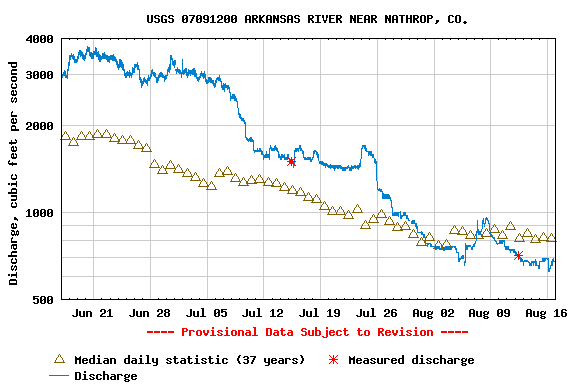
The trip lasted 3 hours. The guide told us about a 4 day trip where they start further North and bring a supply raft, sleeping on the river edge. After rafting it was off to another Country Buffet.
During the afternoon we went to a National Historic Site, Bent's Old Fort. This was a reproduction of an 1830's fort that was a main trading post on the Santa Fe Trail. It was one of the first spots where Indians, Spanish-Mexicans and settlers traded with out issues.
That evening we travel to the Koshare Indian site on the campus of Otero Junior College in La Junta, Colorado. The Koshare Indians are a Boy Scout troop from La Junta. They have been very involved in their community. The troop had over 600 Eagle Scouts in their history. The group had made an authentic Kiva, an Indian meeting lodge built with stacked logs for a roof, on the site before the Jr college was developed. Later they had added a function room, kitchen, rest rooms, a museum and a gift shop. They had earned the money for this by hosting scout troops passing through to Philmont and dance shows. The dance shows were good, but similar to the GML Gish dancers. We stayed overnight in the Kiva. It would be GREAT if our troop had a building of their own. We could probably skip the gift shop.
Philmont
In the morning we were up early and on the road by 8 AM to Philmont. We arrived by 10:30, dumping everything out of the bus and forming the first of many to follow pack lines. After getting processes, inspected, detected and not rejected we were placed into the "off road" tent farm. We met our ranger, Ryan Raef, who would be with us the first 2 nights on the trail to give us training on what was expected of us. Rangers were mostly boys that had been Eagle Scouts. They all wore a uniform of a Philmont polo shirt and shorts. We had the rest of the day to pick up our stoves from the mail room, get our patrol gear and food released and check out the trading post. It would be the last day of normal life that included flush toilets.
The next morning we had our pack inspections. We all took our beds out of the tents and put everything out that we planned to take with us. Ryan checked that we had tents, rain gear, shirts (2 necessary, 3 luxury - including the one on your body), pants, socks, a spoon and bowl, flashlight, stoves, fuel, a first aid kit and containers that carried at least 3 liters of water. He also checked for smellable things that would attract bears, like deodorant (some people did not get the memo). I put everything in my old school pack. It was one that I used as a scout back in the 1970s. I was determined to use this as my pack as I had used it for scouting since that time. It was as good a pack as those 30 years younger. Once we were packed we had a lunch of the last real food at the cafe. Our sister crew left on a 1 PM bus out to the Six Mile Gate drop off point. Our bus was at 3 PM so we had time to get a tour of Waite Phillips summer home villa. Nice place, wish I had one.
On the bus ride out we got a talk from the rangers about Window Rock, the Tooth of Time and all things Philmont. The Tooth of Time is a large rock formation that travellers on the Santa Fe Trail used to know that it took 7-10 days from there until you reached Santa Fe. Nobody knew how old TTOT was , but it was old and probably celebrating a birthday. First thing off the bus was a visit to the Red Roof Inn, or the upgraded latrine. Ryan showed us how to first find a stick and use it to knock around the seat to dislodge any bugs that may be hiding there since some of RRI in the back country do not get used that much. good idea. Then it was off to our first overnight at Sioux campsite. We traveled through Ponil which was the first base camp for Philmont. Waite Phillips had donated the ranch to the scouts in 2 waves. Ponil served as base from 1938- the late 1940s when local flooding made it hard to have a permanent camp there. We passed a commissary where we learned that they had fresh fruit for the asking.
We had a short climb up to Sioux that made us all think wow this is a tough climb, I hope we all make it. Setting up at the camp, we got the now classic talk from Ryan on "chunking the rope over the bear line". At Philmont there are steel cables installed between 2 trees that you toss a cotton rope over to secure your food and smellables overnight or when you leave the site.
In the morning we packed and went down to Ponil. On the way I was thinking wow that climb up really did not take that long to get down and didn't look that tough. I have heard that it gets worse. At Ponil we picked up a burro, W77. The boys named him Ed. We were instructed on how to pack him just like the miners had in the 1840s. After getting Ed ready we headed out on the tail to the Flume Canyon campsite, about 5 miles away. At first, our navigator took us the wrong direction. Ryan was watching over us and made sure that the boys knew how to read a map and figure out where we should be heading.
At Flume Canyon we settled in campsite #4. This was the best campsite of the whole trip. The site had a local bear cable, a fresh stream take water, a RRI nearby and these really sweet recliners made from large flat rocks. Ed went up to a burro trap where he was fed.
On the next day, we headed out to Head of Dean campsite. Ryan had left us early. He had imparted all of this ranger knowledge on us and we were good to go. He left us with a pound cake and a jar of frosting to have a birthday party for TTOT. On the way to HOD we passed a crew that had tans, beards, and looked dirty. They asked us what day we were on. We had to think of it. Day 1 is at base camp, Day 2 the day you start hiking, so this was the morning of Day 4. They were on Day 10. It now became part of the greeting when we met a crew, "Hey what day are you on?"
Early that day we passed through Pueblano, a staffed camp. The people who are at the staff camps are usually college age men and women who are on their summers off. Most have been scouts or had gone to Philmont, but many had not. They wore clothes that represented the theme of their camp, usually 1800s period clothes. At staff camps you meet up on the porch for a Porch Talk with the staff. They go over what the theme of the camp, where the trash receptacles are located, and if the water in the spouts is potable. Staff Camps also have Swap Boxes, where you can trade in meals that you have for meals that are better. Boxes near the end of treks had a lot of food that people were not going to carry for the next day. We scored some full meals that we held onto for the Mt Baldy trip. These boxes had a lot of items that were disgusting and no one wanted, like green beans.
This camp was set up to show how rail ties and mine timbers were cut from the Douglas firs and Ponderosa pines. This camp also had Spar Pole Climbing. A spar pole is a tree that they would strip off all of the lower branches and use as a pivot point to haul logs down the mountain. It is easier to lift the log and carry it on angle than drag it on the side. Lumberjacks would have to cut new spar poles along the path that lumber would travel. This camp had a program where we could climb a tree as the lumberjacks would have done. Before this happened we had to have a Pole Talk, a presentation from a staff member on what we were doing and how we were going to do it safely.
The camp program director called over someone who was using the stage name of Swede. He was dressed in a bright red pair of long johns, the kind with the flag on the back side and a top hat. It was early (11 AM) and he looked like he wanted to be back in bed. The talk was going real slow, but then he kicked into it and started acting out what we were supposed to do. He showed us how to put the leggings and belt on. More importantly it was how to make it look good. how we put the climbing belt over our shoulder. why? because it looked good. Alec was on the other end of his safety rope, belaying him or holding him if necessary. This job was usually performed by a donkey in the 1800s. You had to be nice to your donkey and compliment it when ever possible. After all, your life was in his hands. Swede started to climb the pole. He was explaining how to climb and what techniques to use. One was to make sure that you were putting the climbing spike well into the pole so that you would not slip. If you imagined that you were putting the spike into kittens or baby seals it may help. Swede then makes little meowing noises when he jams the spike in. Next he showed us what not to do and why it could be a problem. We showed that you did not want to loose your footing and slip with the spar between your legs. It could get splinters in to your unit and then you would be peeing splinters. He then serenaded us with a song about peeing splinters while hanging upside down in the spar. All this in the red long johns. I had not laughed this hard in months. Once Swede reached the top he showed us that we had to kiss the caribiner to thank it for holding us, make a manly pose and then say something manly loud enough that it would echo through the canyon. Then he repelled down the pole with the aid of the donkey. At the bottom he threw his gloves to the ground. why? because it looked good. We all had our own climb, making manly poses, shouting manly things, and making it look good. Our sister crew really messed up missing this program.
After the spar pole climbing the boys went to the local burro trap to get Ed. We should have put our food into the metal box there. When they approached the shelter a red squirrel or weasel ran from the location. They found that it had eaten through the saddle bag, through the other bags and through the aluminum backing on OUR POUND CAKE! It had eaten about a cup's worth of cake. This was our first experience with a mini-bear attack. You probably will not see a real bear at Philmont, but are always under attack from mini-bears (chipmunks, squirrels, weasels). We packed out and went to Head of Dean.
HOD is one of the older, larger staffed campsites at Philmont. It is a high altitude meadow. We checked in and were lead to our assigned campsite. At trail camps you get to pick your site, at staff camps you are assigned. We took our packs off, broke out lunch, said grace and started to munch. Shortly after I see this red squirrel running at full speed into our camp. It runs right up and jumps into Matt's pack! I get up and yell. It jumps out and goes around the back side of the pack, sticks its head into a graham cracker box and starts to pull a cracker out. I throw a water bottle at it. The mini-bears at this camp were like the Mafia: well organized, showed little fear and attacked in groups.
Our crew met up with the sister crew for some team challenge events. They had located us with the cry of Wolverines from the Red Dawn. The challenge events included the 10 person lift, get through the 'spider web', get across the 'lava pit' and climb the 12' wall. The boys all had a really good time.
In the morning we awoke to find 3-5 deer in our campsite. There is no hunting on the ranch, so the animals have little fear of humans. There were 2 four-pointers and a six-pointer within 15 yards of our camp. After breakfast the boys went down to get Ed from the burro trap. On the way down Alec said that they saw this burro run out of the woods full speed directly at them. He thought it was strange. The burro ran right up to them. They then saw that it was W77, Ed. He had escaped from the pen over night. It is a good thing that he found them and we did not have to find him. Ed might have got out since the water pond there had a lot of algae and did not look good. Ed drank 8 gallons of water from a pot once he got to camp. We hiked to the Miranda camp where we left Ed with the wranglers there. During the planning process we selected the route that we wanted to take based upon what areas we wanted to hike and the boys wanted to do rock climbing, shooting and horse back riding. We had not considered the burro packing. There are only 8 treks of the 36 that have burros and it just worked out that the trek we chose had a burro. All of us agreed that this was one of the best things on the trip. Ed had gotten attached to us and we to him. It was sad to see him go.
At Miranda the boys did some tomahawk throwing and black powder shooting. There was a low altitude B1 bomber fly over while we were there. Later we hiked on to the Ute Meadows campsite. On the way we saw a mother turkey with about 12 small turkeylings cross our path.
Ute Meadows is a trail camp site that we were going to be at for 2 nights. The next day we would summit Mt. Baldy, the ranch's highest peak. The camp was at 9500' and the peak at 12221' - a good day's hike. We would be able to leave our full packs there and only have carry day packs. The campsite selection was not great at this camp. The camps had all been well used since a lot of crews make the Baldy trip. It had rained while we were at Miranda. The streams that we took the water from were tan with dirty that had been washed into the stream. Ryan said that this happened for a few hours after a storm, but the water was still good. We did not realize that this fine dirt was going to clog the filters in our pumps until the next time we needed water.
We were up at 0530 and out of camp at 0610 for the morning hike. We got to the Baldytown camp at 7:15 before anyone was up. Baldytown was a location of a town that had about 2000 people during the gold rush of the 1840's and 1850's. At the base museum they had said that more gold was taken out of Baldy than all of the California gold rush. We moved on and up the hill getting to the saddle of Badly about 0900. We checked out the meadow just above the trail and tree line. It had some spectacular views. Back on the trail we got to the summit at 1100. The last 900 vertical feet were real tough. The oxygen is thin in the air. I had to take full lung breaths, climb about 50 feet, wait about 15 seconds and go again. Once at the top we relaxed and had lunch. We were impressed that our entire sister crew got to the top about an hour after we did. We took off down the back side of Baldy. It was a steep climb down. We chose to take a steep, more direct route. This path was full of loose rocks that were about 6"x6"x10". It was hard to determine if this was really a trail. The ridge trail might have been an easier hike, but was 2miles longer. We arrived at the French Henry staff camp at 1340. When we had the porch talk we learned that all of the program time at this location had been filled. What a waste of time coming here rather than just going back down. The staff was not all that friendly either. Every other crew we saw we recommended skipping this camp.
We got back around to Baldytown about 1530. We picked up our provisions for the next we days at the commissary. We also had the first showers in 5 days and got to wash our clothes in a tub. Baldytown also had a trading post. We found out that they did not have any chocolate. I had been wanting that for days! The trading post was also staffed by 2 boys who were Russian. It was just weird that there were these 2 Russians out in nowhere running the store. It could have been this way 160 years ago. They did have a sign stating that they only accepted Rubles. Back at Ute Meadows we relaxed and had our cake to celebrate the TTOT's birthday and our day's trek. I had some of the section that had mini-bear spit on it. I still seem fine.
From Ute Meadows we moved on to the trail camp Upper Dean. This was a remote camp in a valley. Only a few other crews passed through and there were 3 crews in the camp that had 8 sites that were spread out about a mile. When looking over camps I came across 9 turkey hens that I had got to within 10' before I realized they were there. They were sitting in the tall grass. This camp had many resident deer that would wander through our site grazing. Luckily there were no mini-bears. It was also the second day in a row that it had not rained. We did not miss the rain, but it had become really dusty. Just a little rain would have helped.
This was a great night. We had a good rest. The hike today will be one of the longer ones so we start out early. This is Day 8. We are more than half way through and feel good about it. We missed a turn off on an unmarked trail and end up in the New Dean camp. The distance we will have to go is about the same. We head up a fire road and meet another crew of older guys. "What day are you on?" Day 16. A Rayado crew. They are made up of a contingent crew and go out for 21 days. Ryan had been on one before our trip. They plan their own trek apart from the numbered ones. These guys are out here for the hike, not the program. Hooah!
This is turning out to be a really hot day. We cross under the highway to the Southern part of the ranch. Climbing back up some altitude it is humid and really warm, seems like 95 degrees. We stop for lunch at Visto Grande camp. While we are stopped we put a thermometer on a rock out in the sun. It measures 118. It is 90 in the shade. We fill up our Nalgene bottles and put 2+ gallons in some extra large containers we have. The camp we are staying at, Upper Bench, is dry and we need to carry this water the 1.6 miles. As we get going the clouds start to come in and give some shade. About 1/2 mile from Upper Bench it starts to hail. Just a few pea sized hail stones, no rain. It is still sunny and I wonder it there is a hailbow. We put on the pack covers and keep moving. The hail lets up. It is cooler now, in the lower 70s. We arrive at Upper Bench and pick our site. We just get our rain tarp up and the hail starts again. This time it is mixed with really large rain drops. Sixty seconds later it pours, really pours with the pea sized hail and lightning. This lasts for 20 minutes. It was a good storm, but we had a good hail storm back in June that was considered 'epic'. Temperature is now in the mid 60s. After a 5 minute respite the storm comes back. Total time is 2 hours of heavy rain, hail and lightning. This has now put that storm in Groton to a minor classification. We start to think about our sister crew and assemble people to go meet them and help them in. Just as we are starting out we hear Wolverines!. Good for them, they made it through the storm out on the trail and are headed in. Upper Bench, except for being dry, turned out to be a really nice campsite as well.
In the morning we are headed out to Devil's Wash Basin to participate in a conservation project. To earn the Philmont Arrowhead Badge, one must participate in a 3 hour conservation project. A new trail is being constructed to DWB. We get an hour talk on how and why you build trails. We got tools assigned and head out to do some work. I get a sledge hammer and pound away on a rock that was sticking out on the new trail. Left my mark on Philmont.
Back on the trail we run into a crew from Texas. We look at them and see that they are all wearing their ultra clean crew T-Shirts. We can tell before we ask "What day are you on?". Day 2. NEWBS. They still have their mother (ranger) with them. yeah, that was us. good luck guys.
We cruise down to the Ute Commissary to pick up our last ration of food. There is a Trading Post here as well. They do not have any replacement filters for the water pumps so we are still going to be drinking water with iodine or MicroPure (pure-dubers) tablets. Also no chocolate here! bummer. Eat lunch, hang out, dry everything from the epic hail storm. Rumors are that a supply truck is coming and there will be Toblerones on it. We wait and score four each. On to Cimarroncito or Cito as it is known. This will be a 2 night stop over with showers that we are all looking forward to.
Cito has rock climbing and a nature talk. We hit the rock climbing at 0745. The climb itself is not that challenging, but everyone has a good time. Lots of manly poses for the camera. After the climb we go with Matt, a staff member from Cito, and the sister crew for a 2 hour nature hike. He talks a lot about the types of trees and flowers in the area. We visit Hidden Valley which is a really beautiful meadow that makes the hike worth it. From there our crew heads off to Window Rock to check it out. We have lunch on what we think is Window Rock. We have a couple of GPS waypoints for it. We are at one of the waypoints, but we are not impressed at what we find. Later we find the real Window Rock and the boys climb all over it with the adults saying "If your mothers were here they would be freaking out about that 400 ft drop...". We hike down some annoying switch backs to Waite Phillips hunting lodge. He had this build out in the hills for his Man Cave. It is a cool place. The hunting lodge is a staffed camp. We get a tour of the cabin. The staff is 'in character' and telling us tall tails. When we ask more questions they give us some answers that leave us thinking that they must really think we are stupid if we are going to believe that. Overall worth the stop, but it would have been better if it was not staffed. Back up to Cito for the night. We put in 12.5 miles. It was a long day for a one that we were supposed to take off.
The next morning it is Day 10. Double digits. We are getting frosty. The end is in sight and some of the crew are getting short timer's. Tired of the food, the rain, the walking, the sleeping in a tent. They list the thing they want to do or eat when we rotate back into the world. For me it means going back to work or something equally boring. I start thinking about hooking up with the next Rayado crew we come across.
We get to Clark's Fork early. We need to go on to another dry camp, Ponderosa Park, and come back here for dinner later. For now we help the staff light a fire for branding. A little Scoutmaster white gas helps. We brand almost everything we have. Joe want to brand Patrick, but we are too tired to hold him down. Head back on the trail to Ponderosa Park. This camp makes Ute Meadows look good. They had changed the trail coming into the camp, but not the signs showing where the campsites are located. So we can not figure out where we are and it takes about 40 minutes to locate a campsite. We get the tents setup and head back to Clark's Fork for horse back riding. I am over 200 lbs so I do not qualify for a ride. Rain delays the ride for 15 minutes, then the crew is off.
Dinner tonight will not be dried stuff that we have been carrying around. It will be a Chuck Wagon Dinner. We send 2 cooks down from our crew to help. The dinner is beef stew that was stored in large poly bags. Something you might find at Costco. It is not something that I would buy, yet after the week of dried food it tastes good. The cooks have made biscuits and a cobbler in dutch ovens. There is a Rayado crew made up of women that come to the Chuck Wagon. Probably can't go with them. After dinner we are stuffed. Hiking back up the 1.3 miles to the campsite we realize that it is better to pig out somewhere if you do not have to hike afterward.
Last morning on the trail we wake up at 0530. Pack up and head out on the trail by 0630. This is a long day hike. We hope to be back at base camp to enjoy some time there. We get to the Tooth of Time base camp at 0900 and form at pack line. We will bolder up to the rest of the 500 vertical feet to the 9900' outcropping. From there we can see Mt Baldy. Six days ago we were at the summit. It is a long distance away. We covered a lot of ground since then. We can see both sides of the ridge where the cattle ranch spans. We can see base camp. It is within reach.
Down from TTOT we meet our sister crew. They look like they are feeling the heat. We are off to base camp. There are 2 trails straight down to base camp. One was created by Waite Phillips using dynamite for a short cut to the Tooth. Both are officially closed off since there have been too many ankle sprains on the trails. We are taking the long way. This covers several switch backs. On one end of the switch back you can see base camp. Each time it is a little closer, still annoyingly far away. The last mile of the trail is out in the sun. No clouds, no shade. It is hot, we keep truckin'. We can see the gate into camp. The boys decide that they are going to sprint the last 100 yards with their packs on. I am 49 and still have some time left. I will walk it. We assemble under the We Made It! sign and put the camera on the post for a picture. No one wants to take the time for a second picture. It is 1300 and we have time to relax. We pass by the staff tents going into camp. Several staff see us and yell out 'Welcome Back'. Thanks guys, that meant a lot to us.
We check in, get the keys to the lockers, grab a couple of sodas and Zebra cakes for a victory toast. My GPS says 102 miles. It was not on all the time so there are a few extra miles. We get assigned tents in the 'off trail' section of camp and drop our gear. Showers and fresh clothes are in order. Later Alec and I are sitting at one of the picnic tables centered in the cluster of tents. Starting to realize that the trip is concluding he says 'That was a good time, huh?' Damn Straight I reply. I have been out with my son for 12 days on a back packing trip in the mountains of New Mexico. It may be one of the last times that I get to do something like this with him before he goes off and becomes a man. Before school, college, work and women get in the way. I will cherish this trip.
Two weeks after the trip I get an email from one of the other leaders on the trip pointing me to an article in the Boston Globe about a man that had been on a trip to Philmont with his son back in 1972 and now at 81 had come back from a trip with his son and his grandson. I have new plans. Make it a Rayado trek. My pack is ready.
Coda
During the closing campfire the MC gave stories of when you were at home before you left for the trip telling your friends and colleages that you were going to go on this 11 day back packing trip in the mountains, carrying everything with you, eating dried food, sleeping in a tent that was never on level ground, no flush toilets, possibility of encountering bears, ... and they would ask Why are you doing this?. They would never understand. When you meet people that have done it they just say with a twinkle in their eye, Good times, huh?.