Tube are still used in guitar amplifiers due to the warm tones when driven into the non-linear overdrive. Transistors have replaced tubes in most other applications since they are smaller, require less power and have better reliability. However transistors just don't have the same sound.
Amplifiers have two different stages, preamp and power amp. Both stages can reach saturation and have different tonal qualities. The preamp stage can have a couple of gain stages, often split into separate channels, to increase the volume and shape the tone. Each of these stages also allow for a stage to reach saturation. Distortion in the preamp sounds more fuzzy and raspy where distortion from the power amp section is heavy and meaty. Think Green Day versus Cream/early ZZ Top. Power amp distortion also has a level of compression of the sound when the tubes are driven to the non-linear range. Unfortunately to achieve power amp distortion the output volume needs to be near the maximum. An iconic amplifier used to create the classic rock sound is the Marshall JTM45 or 1959SLP ("Plexi").
One of the earliest guitar amplifiers was the el84 based VOX AC15. These followed 6V6 based amplifiers from Fender. The el84 is a pentode design vacuum tube whereas the 6V6 is a tetrode design. The extra gain at a higher plate voltage provides a little more output with more headroom.
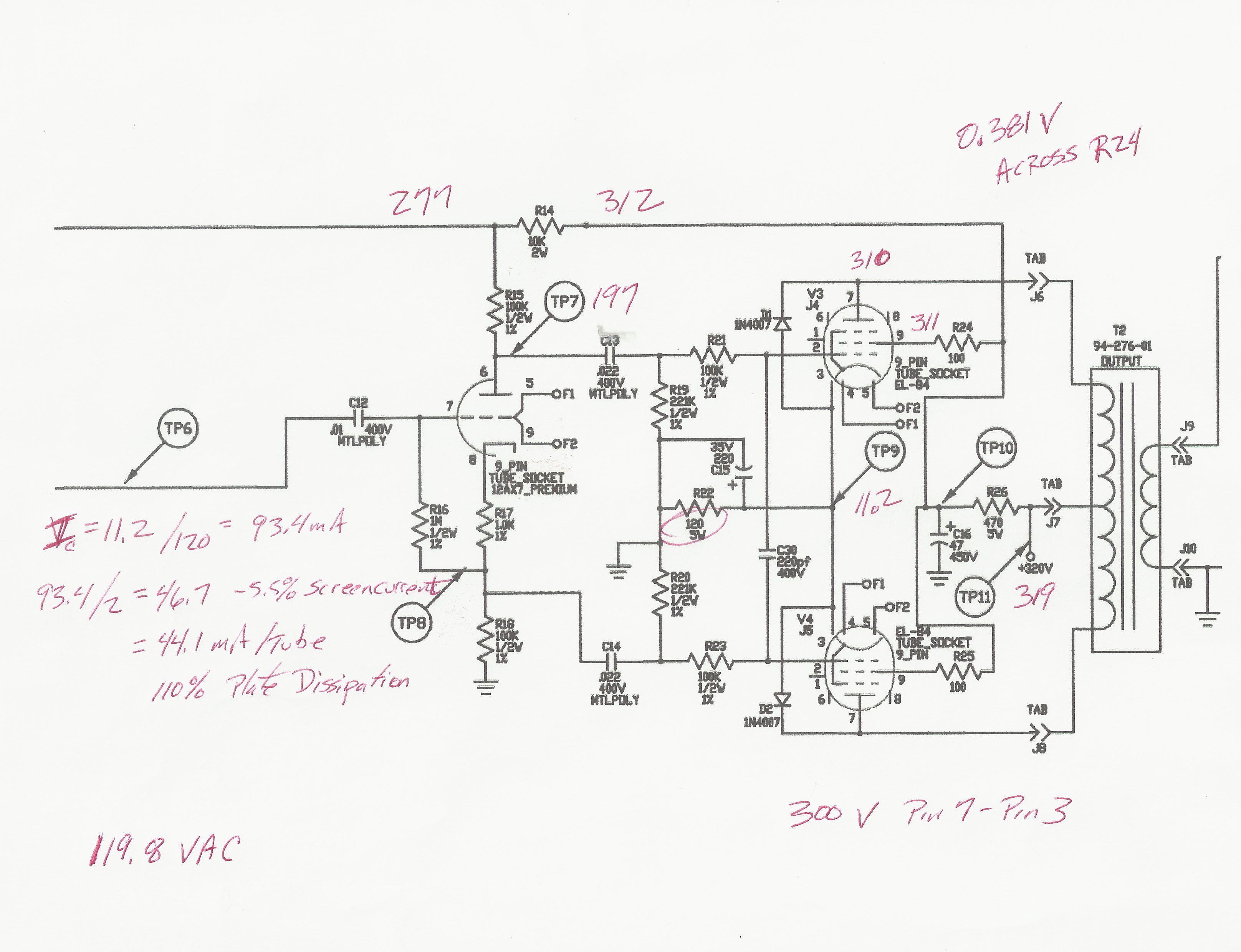
I have a mid-90's Crate Vintage Club VC2110 combo amp with a 10" speaker. It follows the VOX design with two cascaded 12AX7 tubes in the preamp section and a pair of el84 tubes in the power amp section. Similar to the AC15 the plate voltage is 310 VDC. This is above the 250 VDC max specified for the tubes. The higher plate again gives a little more output and with it being above the recommended operating values places the tube in the non-linear range.
Tubes need some current from the anode (plate) to the cathode to operate. There are two different methods to achieve the minimal or bias current, Fixed Bias or Cathode Biased. Fixed bias uses a negative voltage generated from a separate transformer winding in the power transformer which is applied to the gate of the tube. Fixed bias amps have an internal potentiometer to adjust the current for each tube in an output pair. Cathode biased amps tie the cathode of the tube to ground through a single resistor to ground. This generates the negative voltage seen by the gate. Cathode biased amps are less expensive to make due to not needing a transformer that has a separate winding or other components and are easier to maintain when replacing tubes. If you replace tubes with a set that is matched for quiescent current draw a cathode biased amp is essentially "plug and go". Fixed biased amps always should have the anode-cathode current checked and adjusted when replacing tubes.
The VC2110 was designed and built as a cathode bias amp. same as the VOX. Both have a plate voltage of 310 VDC and a bias resistor of 120 ohms. To me it is a good sounding amp, yet I got a lot more Neil Young type distortion than clean tones.
I pulled out the schematic and it told me that the voltage on the cathode would be 9.6V. Calculating the current through each tube yields 38 mA. The maximum Ic is 40 mA, so the amp was operating at 95% of max. Cool. Cathode biased amps can run up to 100%. I measured the voltage at the cathode and the value of the cathode bias resistor, getting 11.2 VDC and 120 ohms. Due to age and part tolerances the cathode voltage was a little higher. The actual Ic that the tubes were seeing was 44 mA, operating at 110% of spec. OK, that's why it is extra nasty. Higher amounts of current lead to more saturation.
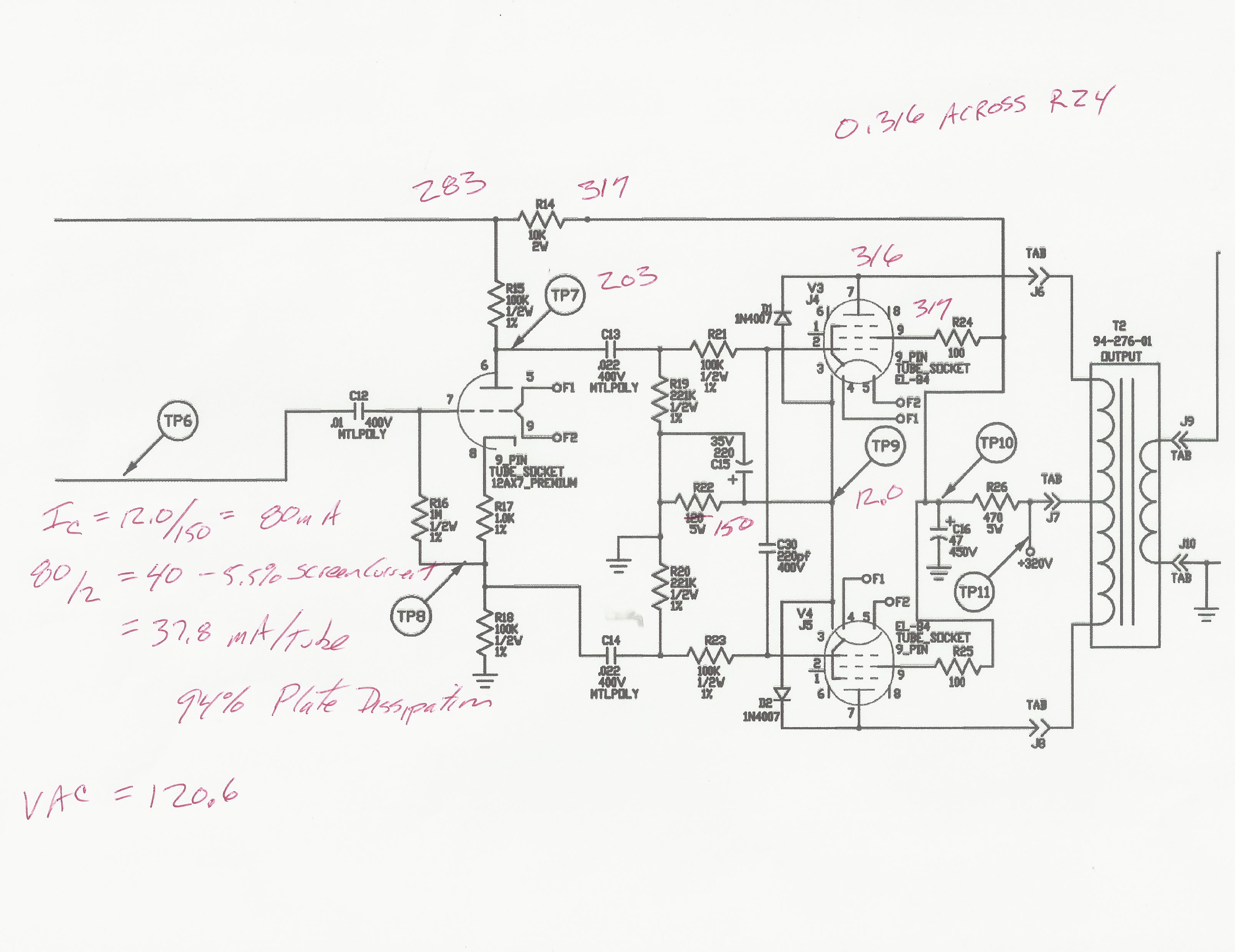
I purchased a few different value high watt resistors. I had seen some other el84 based cathode biased amps have 150 ohm resistors. Trying one of those I found that the cathode voltage was 12.0 VDC. It rose a little. The wall power was slightly higher that day as well. Using 11.2 VDC for Vc, I anticipated 35 mA running at 88% of spec. Instead the higher Vc yielded an Ic of 37.8 mA running at 94% of spec. Right now the amp sounds good. I have a 130, 160 and 200 ohm replacement I can try. I forgot to add the 180 to the shopping cart. I destroyed the 120 ohm part taking it off the boards, but I don't think I'l go back to that value. I'll run it this way for a few weeks and see how I feel.